File icon
(pdf, 10.53 MB)

Commissioner's foreword

As Australia’s national policing agency, the Australian Federal Police (AFP) defends and protects Australia and Australia’s future from domestic and global security threats.

Australia continues to face emerging challenges driven by converging crime types, expanding criminal motivations, threats to social cohesion, and increased targeting of vulnerable communities.

In response to the changing environment, I launched the AFP’s new strategy in March 2026, setting a clear direction for how we work across the agency and how we deliver on our mission. Underpinning the AFP Strategy are 5 enterprise priorities that focus our efforts, outline the tools and provide the direction needed to achieve our mission. The AFP Strategy is being implemented across the agency and is at the forefront of how we set priorities, direct resources and make decisions.

The AFP Strategy enables the AFP to operate as one workforce, strengthen collaboration, and target action where it has the greatest impact, while positioning us to remain agile, intelligence led and ready for future threats.

It is critical that we meet the expectations of the community and key stakeholders. This requires a workforce where members feel valued and can see the value in the work they do.

That is why one of my priorities is futureproofing our workforce. This means attracting and retaining high-performing people by supporting career development and movement across roles, and ensuring our employment conditions, health and wellbeing support, facilities, training and culture enable our people to work effectively and safely, placing people at the centre of the delivery of our mission.

We are supercharging global operations, maximising the AFP’s global impact through the strategic use of our resources and offshore presence. By strengthening global collaboration and partner-country resilience, and enabling rapid police-to-police engagement, we are disrupting threats before they reach our borders and protecting Australians offshore. This is particularly evident across the Pacific and in our contribution to AUKUS, where coordinated international efforts enhance our ability to prevent and respond to offshore threats.

Central to the AFP’s role is defending Australia’s domestic security and our region, supporting stability and safeguarding our way of life. This reflects our core work as a policing agency, protecting the people we serve through our investigative and protective functions, and prioritising the threats that impact Australia’s sovereignty, democracy, resilience and prosperity. Strong partnerships, both domestically and internationally, underpin our ability to build trust and confidence, deliver public safety and respond to an increasingly complex environment.

We are protecting vulnerable communities, prioritising social cohesion and remaining nimble in how we respond to those who seek to damage our social fabric and promote hatred, division and violence against vulnerable and marginalised communities. The AFP continues to support the work of the Royal Commission on Antisemitism and Social Cohesion, and we keenly anticipate the final report and recommendations due later in 2026.

We are investing in science and technology-led capability, including artificial intelligence and systems for managing and analysing information, along with rules and safeguards to ensure these technologies are used ethically and responsibly.

Our performance framework, including our performance measure for community confidence, is an important means by which we assess our performance and assure Australians that we are delivering on our mission. In this 2026–27 Corporate Plan, we continue to refine and mature our performance framework, notably by introducing significant reforms to our performance measures. These provide Australians with greater clarity on the methodology and parameters for success for each performance measure. We are looking forward to reporting on our performance against these measures in the 2026–27 Annual Report.

As AFP Commissioner, I can assure Australians, the Australian Government and our partners that the AFP will defend and protect Australia’s sovereignty, security and future prosperity.

Statement of preparation

I, as the accountable authority for the Australian Federal Police, present the AFP Corporate Plan 2026–27. This plan covers the 4-year period from 2026–27 to 2029–30 as required under section 35(1)(b) of the Public Governance, Performance and Accountability Act 2013 (Cth). It outlines our purpose, environment and approach and the results we will deliver.

Krissy Barrett APM
Commissioner

About the AFP

AFP Strategy

On 30 March 2026, Commissioner Barrett launched the AFP Strategy to enable a modern, adaptable and influential AFP. The AFP Strategy is the foundational document that provides guidance on how our mission will be delivered. Underpinned by the 5 enterprise priorities, it pinpoints how the AFP will continue to evolve to build on its existing strengths and remain agile against threats. It supports thinking from an agency perspective that embraces the diversity of our people and their expertise, and trusts decision-makers to lead and move forward confidently.

In an ever-changing security environment, the AFP Strategy is ultimately a commitment to ensuring our priorities are at the forefront of consideration when planning and executing all our actions and initiatives.

Our purpose and mission

Defend and protect Australia and Australia’s future from domestic and global security threats.

Our core functions

The AFP’s core functions, as identified in the Australian Federal Police Act 1979 (AFP Act), are shown in Figure 1. Our ‘plan on a page’, which includes our 5 enterprise priorities, operating context themes, capabilities and enterprise risks, is in Figure 2. Together our functions and priorities highlight the distinct role the AFP plays in Australia’s national security and law enforcement environment. In order to perform this role, the AFP employs a broad mix of people and capabilities (page 14) working in a diverse range of functions. The AFP also leverages a large global footprint (page 12) and deep domestic and international partnerships (page 20) to deliver its functions, advance its priorities and ultimately achieve its mission.

Figure 1 AFP’s core functions
  • Police Commonwealth law, safeguard Commonwealth interests and investigate state offences that have a federal aspect
  • Undertake domestic engagement and cooperation to disrupt crime and keep Australians safe
  • Assist international policing and non-government bodies to disrupt crime and support regional security, safety and stability
  • Provide policing services to the ACT, Jervis Bay and Australia’s external territories
  • Protect Commonwealth infrastructure, places and property
  • Protect designated high office holders, dignitaries and witnesses
  • Provide offshore peace, stability and security operations, capacity building, police partnership programs and capability development
  • Confiscate illegally obtained property or wealth from criminals
  • Provide other policing functions essential to our national security role, including protective and custodial services

Our operating model

Following the launch of the AFP Strategy, the AFP will uplift its operating model articulating decision‑making authority, roles and responsibilities of commands to ensure strategic priorities are embedded in our work. This will support how the agency maximises its mission, outcomes and national security impact through the alignment of our people, resources, strategy, technology and partners to act as one AFP. Simultaneously, it provides the agency with the flexibility required to address community and governance needs, and shifts in the operating environment. Success will be measured through impact, prevention, disruption and trust, rather than activity volume (e.g. arrests, charges, seizures of illicit commodities).

Plan on a page

Figure 2 AFP plan on a page

Operating context themes

  • Global shifts and global dynamics
  • Social cohesion and extremism
  • Vulnerable communities
  • Technology and criminal innovation
  • Convergent crime ecosystems

Mission

Defend and protect Australia and Australia’s future from domestic and global security threats.

Priorities

Defending Australia’s domestic security and our region

We provide policing and protective services to defend and protect the Australian community and our region. We prioritise threats and crimes which will impact our community and Australia’s sovereignty, democracy, resilience and prosperity.

Protecting vulnerable communities

We prevent and disrupt threats and crime actors which seek to harm or radicalise vulnerable communities. We prioritise safety and social cohesion, and are agile in responding to those seeking to damage our social fabric and create hatred, division and harm.

Supercharging global operations

Supercharging means amplifying the AFP’s impact globally. We leverage global connections and advanced policing capabilities to protect Australia’s interests, working with partners to solve problems and prevent harm before it reaches Australia.

Futureproofing our workforce

Our workforce is thriving, unified, diverse and trusted — empowered by adaptive and accountable leadership, guided by integrity, and equipped to adapt to emerging challenges.

Investing in technology and capability

Science and technology-led capabilities are at the forefront of how we operationalise our business. We use science and technology responsibly to stay ahead of threats, delivering more effective policing while earning public trust.

Fairness | Trust | Respect | Accountability | Integrity | Commitment | Excellence

Capabilities

Operational policing and protection
  • Community policing
  • Investigation
  • Crime prevention
  • Global
  • Specialist response
  • Protection
Foundational
  • Training and exercising
  • Organisational management
  • Security
  • Leadership
  • Organisational improvement
Specialist and technical
  • Digital exploration
  • Data exploitation
  • Intelligence
  • Tasking and coordination
  • HUMINT
  • Forensics
  • Surveillance

Enterprise risks

  • Health, safety and wellbeing
  • Culture, standards and integrity
  • Operational outcomes
  • Partnerships and stakeholder management
  • Effectiveness of AFP capabilities
  • Workforce
  • Resourcing
  • Information

Our operating environment

The AFP’s operating environment is shaped by national and international geopolitical, social, economic and technological changes. We need to anticipate, adapt to and respond to evolving expectations while maintaining a clear understanding of the increasingly complex, agile criminal environment.

Geopolitical shifts and global security dynamics

Geopolitical shifts are reshaping Australia’s security landscape and are having an ever-increasing impact on the AFP’s operating environment. Rising security tensions and the shifting state of global affairs are influencing our international policing efforts and national security environment. As global conflicts, economic uncertainty and evolving strategic competition impact Australia and the region, upholding the AFP’s mission is critical, requiring partnerships with non-traditional counterparts and an agile focus to anticipate changes.

Rapid global change is increasing corruption risks and creating opportunities for criminals to divert or illicitly obtain resources, particularly in unstable regions. At the same time, criminal threats are becoming more sophisticated. In response, the AFP will further integrate its operations and strengthen partnerships with international law enforcement agencies to mitigate emerging threats and build resilience now and into the future.

The AFP’s Pacific and regional relationships are critically important to ensure the AFP is in a position to anticipate any emerging developments that could impact our national security.

Social cohesion and extremism

Community confidence and trust are essential for effective policing. Community expectations are continuallyredefining the way we approach evolving criminal methodologies and crime prevention. Results from the AFP Community Confidence Survey continue to show strong levels of trust and confidence in us. Ongoing effort will be needed to maintain these levels of trust and confidence in the face of rapidly changing social norms and those who seek to undermine social cohesion through promoting hostility and radicalisation.

The convergence of terrorism, foreign interference, hate crime, cybercrime and disinformation creates a complex threat environment. In environments characterised by mistrust and social division, foreign governments and their proxies may seek to exploit tensions to advance strategic narratives and undermine confidence in institutions and democratic processes. Availability of extremist material online remains a challenge, supporting activity by lone actors and small groups. Rising antisemitism, Islamophobia and politically motivated violence, amplified by global conflicts and domestic polarisation, further threaten vulnerable communities and democratic institutions.

We will continue to adopt proactive community engagement strategies which build trust and deepen cooperation between law enforcement and communities, particularly with local leaders. We also remain committed to monitoring and targeting extremism and threats to social cohesion in Australia, including through ensuring our workforce comprises people with diverse skill sets and backgrounds. In 2026–27, we will begin to stand up a forward-leaning response to the evolving threat of online violent extremism and terrorism.

Vulnerable communities

Threats such as online child sexual exploitation, cybercrime, serious organised crime, terrorism, foreign interference and human trafficking have intensified and are becoming more sophisticated. More young Australians are increasingly being targeted by offenders attempting to exploit them, including through radicalisation using online spaces such as social media and gaming platforms as indoctrination tools. Malicious actors and organised crime groups are also recruiting adolescents into crime-as-a-service.

Diaspora communities continue to be affected by threats of violence, intimidation, harassment, information collection and other malicious activity, including foreign interference. Scam centres enabled by human trafficking, run by organised crime groups, are adversely impacting our region.

Working with our intelligence capabilities and partners we remain committed to disrupting criminal activities that impact our vulnerable communities. We will deepen our engagement with communities and partners to strengthen resilience, improve understanding of threat indicators and support early reporting of concerning activity. These efforts will contribute to a more resilient community environment and reinforce Australia’s status as a hostile operating environment for adversaries seeking to intimidate, exploit or interfere with vulnerable communities. We are also actively enhancing our capabilities to monitor and disrupt emerging threats before they impact Australia and our region.

Technology and criminal innovation

Offenders are using the rapid advances in technology to commit crimes more quickly and with greater anonymity by engaging in cybercrime, exploitation, money laundering, financial crime and border-related offending. Artificial intelligence, encrypted software, online platforms, drones and cryptocurrency are frequently used to increase the scale and reach of offending and to aid in evading detection.

The AFP is focused on accelerating investment in digital capability and technical skills that align with legislative frameworks through a human-led, responsible and ethical approach. This will help strengthen national resilience, deliver upstream disruption and enable collection of intelligence on criminal innovation.

AFP involvement in multinational taskforces against organised crime provides coordinated real-time intelligence sharing, aligns our priorities with those of global partners, and contributes to simultaneous cross-border disruptions.

Convergent crime ecosystems

The convergence of criminal methodologies is increasing, with traditional crime and national security threats becoming more closely interrelated. Criminal actors are using shared networks, technologies and financial mechanisms in ways that reinforce and enable criminal activity. This has contributed to a more complex and blended threat environment, making criminal activity harder to identify and disrupt.

Highly adaptable adversaries are exploiting borderless networks and systemic vulnerabilities to fund their organised crime. Amid escalating economic and cost-of-living pressures, criminals are seeking to capitalise on vulnerable Australians through scams and other fraudulent schemes.

The AFP will continue to leverage its global and domestic partnerships to proactively disrupt increasingly convergent criminal ecosystems in the region. The AFP recently adopted a new organisational structure that positions the agency to ensure it is well placed to meet the current and future demands imposed on our operating environment by converging criminal ecosystems, particularly where the harm to national security and communities is heightened.

Our locations

Figure 3 Domestic locations

  • National Headquarters (ACT)
  • Office locations:
    • Adelaide Office
    • Australian Centre to Counter Child Exploitation
    • Australian Institute of Police Management
    • Brisbane Office
    • Cairns Office
    • Darwin Office
    • Gold Coast Office
    • Hobart Office
    • Melbourne Office
    • Perth Office
    • Pinkenba Training Centre
    • Sydney Office
    • Thursday Island Office
  • Official and Protection Establishments
    • Adelaide Airport
    • Adelaide Commonwealth Establishments
    • AFP Headquarters
    • ANSTO
    • Australian Defence Satellite Communication Station
    • Australian Parliament House
    • Ben Chifley Building
    • Brisbane Airport
    • Brisbane Commonwealth Establishments
    • Canberra Airport
    • Canberra Diplomatic Protected Premises
    • Canberra Official Establishments
    • Cairns Airport
    • Darwin Airport
    • Defence Canberra
    • Garden Island
    • High Court of Australia
    • Holsworthy
    • HMAS Stirling
    • Joint Defence Facility Pine Gap
    • Melbourne Airport
    • Melbourne Commonwealth Establishments
    • Melbourne Diplomatic Protected Premises
    • Naval Communications Station Harold E. Holt
    • Perth Airport
    • Perth Commonwealth Establishments
    • Perth Diplomatic Protected Premises
    • Sydney Airport
    • Sydney Commonwealth Establishments
    • Sydney Diplomatic Protected Premises
    • Sydney Official Establishments
    • Western Sydney Airport
  • External Territories
    • Christmas Island
    • Cocos (Keeling) Islands
    • Jervis Bay
    • Norfolk Island

Figure 4 International locations

  • International Posts
    • Abu Dhabi
    • Amman
    • Ankara
    • Bali
    • Bangkok
    • Beijing
    • Beirut
    • Belgrade
    • Berlin
    • Bogota
    • Colombo
    • Dili / Timor-Leste
    • Dubai
    • Guangzhou
    • The Hague
    • Hanoi
    • Ho Chi Minh City
    • Hong Kong
    • Islamabad
    • Jakarta
    • Kuala Lumpur
    • London
    • Los Angeles
    • Manila
    • Mexico City
    • New Delhi
    • Ottawa
    • Paris
    • Phnom Penh
    • Port Moresby / Papua New Guinea
    • Port Vila / Vanuatu
    • Pretoria
    • Singapore
    • Suva
    • Vientiane
    • Washington DC
    • Wellington
    • Yangon
  • Pacific Bilateral Policing Partnerships / UN
    • Dili / Timor-Leste
    • Nauru
    • New York
    • Port Moresby / Papua New Guinea
    • Port Vila / Vanuatu
    • Samoa
    • Solomon Islands
    • Tonga
  • Secondments
    • Alabama
    • Lyon
    • Pittsburgh
    • Samoa
    • Wellington
  • Jakarta Centre for Law Enforcement Cooperation

Our capabilities

The AFP is focused on implementing the new AFP Strategy and ensuring its capabilities are in the right places when they are needed most. This involves strengthening our planning, prioritisation and investment processes, ensuring our people, resources and technology are positioned to have maximum impact in protecting the community and advancing Australia’s national security interests.

Capability planning

As threats evolve, the AFP must make deliberate decisions about where to sustain, uplift and develop new capability. All capabilities must be flexible, scalable and adaptable, and must operate within the right authorising environment. This requires disciplined planning, clear prioritisation and sound investment decisions aligned to agency priorities and the outcomes expected by government and the Australian community.

The AFP continues to develop capability roadmaps that strengthen its understanding of current and emerging capability needs. These roadmaps provide clearer lines of sight between strategic priorities, risk, investment and delivery.

AFP Capability Framework

The AFP Capability Framework is underpinned by intelligence-led analysis, horizon scanning and strategic insights. Capability development and delivery is informed by operational experiences embedded into our processes and systems. Operational outcomes also influence decision-making to ensure relevance and alignment with frontline needs. This approach helps us plan, prioritise, invest in and measure what matters most. It brings together direction from senior leaders with insights from the workforce, providing a clear and practical view of where to focus our effort. It ensures our decisions are informed, coordinated and aligned – supporting smarter, more strategic investment in capabilities.

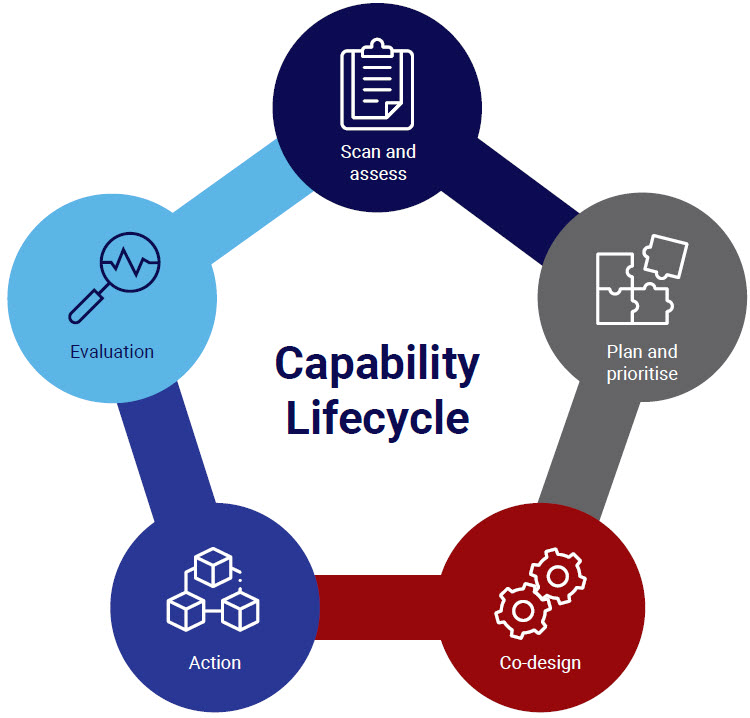
As shown in Figure 5, the AFP applies a 5-phase Capability Lifecycle to identify and adopt smart and innovative solutions to strengthen our capabilities and ensure they are future ready.

Figure 5 Capability Lifecycle

Capability Lifecycle diagram showing five stages: scan and assess, plan and prioritise, co-design, action and evaluation.

By embedding this framework more consistently into planning and governance processes, the AFP is enhancing transparency, accountability and evidence-based decision-making. This ensures public resources are invested in a way that delivers high impact and enduring value. Specific capability projects the AFP is progressing include:

  • uplifting infrastructure to enable advanced training and integrating upgraded technology capabilities to support readiness of specialist members
  • building capabilities for collating digital evidence from various sources on a safe and secure network, with quality-assured data registration. Following successful design work, scoping and testing, this will stabilise and uplift the existing digital evidence network, while also providing quicker evidence examination and intelligence insights
  • enhancing investigation capability by partnering with Commonwealth agencies to establish the Commonwealth School of Investigations, delivering sustainable improvements to investigative, regulatory and compliance outcomes through a professional, multi‑agency community that shares knowledge, builds skills and establishes consistent standards aligned with the Australian Government Investigations Standards
  • implementing our first Stretch Reconciliation Action Plan to build organisational capability, strengthen accountability and embed meaningful partnerships with Aboriginal and Torres Strait Islander peoples across our work
  • delivering our organisational health solution to strengthen workforce capability, health and wellbeing, and operational readiness as core enablers of sustainable performance
  • driving priority improvements to the work health and safety management system to strengthen compliance, embed robust risk practices, and support safer operations for our people
  • strengthening the AFP’s integrity framework through initiatives that improve governance and assurance, and support consistent and effective outcomes
  • reviewing the AFP Investigations Doctrine, a foundational investigative resource, with a focus on enhanced human and technical capabilities to meet the current and future challenges of the domestic and international criminal environment
  • increasing the AFP’s disruption of criminal networks through the application of AI and big data solutions that shorten the time taken to upload and analyse data, identify key convergences and generate investigative leads
  • accelerating the responsible adoption of emerging and evolving science and technologies to deter, disrupt and respond to criminal threats.

Capability set

The AFP maintains a validated enterprise capability set, allowing the agency to determine where to lead, partner or leverage capability, depending on the context and threat environment.

The capability set integrates workforce planning, ICT and infrastructure attributes in a coherent model. It demonstrates how developing employees and building their skill sets allows us to develop key assets, systems and platforms that enable delivery of key activities and achievement of our purpose.

Figure 6 AFP capability set

Operational policing and protection
  • Community policing
  • Crime prevention
  • Specialist response
  • Global
  • Investigation
  • Protection
Foundational
  • Security
  • Training and exercising
  • Leadership
  • Organisational improvement
  • Organisational management
Specialist and technical
  • Intelligence
  • Forensics
  • HUMINT
  • Data exploitation
  • Tasking and coordination
  • Digital exploitation
  • Surveillance

Our partnerships

Collaboration and partnerships across public and private, national and international levels are essential to delivering on our purpose. As the AFP’s operating environment evolves and our work diversifies, we will continue to leverage these partnerships to keep Australians and Australia safe. Figure 7 shows a selective, non-exhaustive list of our partners.

Figure 7 Key partners

ACT Government partners

  • ACT Corrective Services
  • ACT Emergency Services Agency
  • Health and Community Services Directorate
  • Justice and Community Safety Directorate

Oversight bodies

  • Commonwealth Ombudsman
  • Inspector-General of Intelligence and Security
  • National Anti-Corruption Commission
  • Parliamentary Joint Committee on Intelligence and Security
  • Parliamentary Joint Committee on Law Enforcement

State and territory law enforcement partners

  • New South Wales Police Force
  • Northern Territory Police Force
  • Queensland Police Service
  • South Australia Police
  • Tasmania Police
  • Victoria Police
  • Western Australia Police Force

Commonwealth partners

  • Attorney-General’s Department
  • Australian Border Force
  • Australian Criminal Intelligence Commission
  • Australian Security Intelligence Organisation
  • Australian Signals Directorate
  • Australian Taxation Office
  • Australian Transaction Reports and Analysis Centre
  • Department of Defence
  • Department of Foreign Affairs and Trade
  • Department of Home Affairs

Community and non-government partners

  • Academia
  • Local leaders and community groups
  • Non-government organisations
  • Private sector

International partners

  • Five Eyes alliance
  • Global networks

Our risk management and oversight

The AFP operates in an environment of layered uncertainty that informs operational planning and decision-making. To support its ability to operate effectively, the AFP maintains well-established risk oversight and management arrangements that embed a fit-for-purpose, integrated approach across decision-making processes.

A collaborative approach is adopted to manage risk through the AFP’s risk profile, which outlines enterprise risks, controls, treatments and responsible parties. Through continuous improvement initiatives, the AFP aims to enhance consistency and alignment with Commonwealth and AFP risk management practices and policies. Together, these arrangements support evidence-based decision-making by providing a clear understanding of organisational risk exposure.

All AFP members are responsible for identifying and managing risks as part of their day-to-day work and decision-making, in line with the AFP Risk Management Framework. The AFP recognises the importance of a positive risk culture to ensure the agency adapts and evolves with the changing environment. The AFP Risk Maturity and Culture Sustainment Plan is supported by a range of initiatives including:

  • assessing and prioritising emerging risks for strategic resource allocation
  • promoting effective risk management practices and improving the skills of our members through the Risk Champion Network
  • conducting annual reviews, adjusting mitigation strategies and strengthening controls based on changes in the risk environment
  • meeting with other government agencies through the Risk Management Community of Practice in an open forum to collaborate and share information.

The enterprise risk model is a critical mechanism for aligning risk management with strategic intent. By examining linkages between each enterprise risk and our enterprise priorities, the AFP can enable forward-looking decision-making. The AFP has reviewed and uplifted the enterprise risk descriptions and opportunities to align better with the current risk environment. The AFP’s tolerance statements have been strengthened, making risk-based decision-making and accountability an easier process for members. A review of the controls and treatments resulted in the AFP merging several controls to reduce duplication and improve realignment with the 8 enterprise risks.

The AFP is continuously scanning for emerging risks that may impact operations, capabilities and Australia’s national security. These developing risks reflect our ever-changing operating environment and can arise suddenly from changes in the geopolitical arena or unexpected organisational challenges.

AFP enterprise-level risks

Figure 8 provides an overview of the 8 AFP enterprise-level risks and their associated opportunities. Our executive boards, Audit and Risk Committee, governance, and business area management contribute to a holistic risk oversight and assurance process.

Figure 8 Enterprise-level risks

RiskOpportunity

Health, safety and wellbeing

AFP fails to provide a safe and healthy work environment with on positive wellbeing. Illness, injury, or other health and safety decrease the wellbeing and performance of its workforce a focus conditions

Investment in leadership, health, safety, and wellbeing supports individuals and teams, building organisational resilience

Culture, standards and integrity

Failure to comply with AFP standards, values, regulatory frameworks, governance, legislation, legal advice and statutory requirements impacts our ability to find solutions to complex problems, foster integrity, build community trust and create a diverse and respectful workplace culture

Alignment of policy and culture fosters leadership, learning, accountability, and respect within the workplace

Operational outcomes

Failure to achieve the AFP’s identified operational or strategic outcomes and objectives will impact trust with the Australian community and/or impact national security

Achieving AFP's outcomes protects Australians, Australian communities, supports national and international relations, prevents crime, and enhances national security

Partnerships and stakeholder engagement

Failure to develop and coordinate effective relationships with the community, domestic and international law enforcement, the intelligence community, Government and non-government organisations, industry, and academic partners, restricts our ability to achieve optimum results

Strong partnerships support AFP's ability to access, build and sustain our capabilities, support communities, and achieve the best possible results for the AFP

Effectiveness of AFP capabilities

Ineffective management, bundling or exploiting of resources restricts the development of innovative capabilities and infrastructure solutions resulting in a failure to adjust to a changing operating environment

Investment in new capabilities drives innovation, builds skills and organisational agility, and promotes leadership. The AFP can harness its operational, technical skills and workforce, to achieve its operational objectives to intersect with an evolving crime threat environment

Workforce

The AFP fails to recruit, retain, develop, and maintain staff with the right skills, qualifications, and attributes to shape a workforce that meets current and future organisational needs

Targeted recruitment, personal development, strong culture, robust workforce planning, training and development and member supports will enable the AFP to achieve its strategic objectives

Resourcing

Mismanagement or misuse of finance and resources limits AFP’s ability to build capabilities, retain public confidence, shape its workforce, and equip its personnel for success

Optimising the AFP’s finances and resources drives the achievement of objectives, now and into the future

Information

Failure to effectively access/collect, use, manage/store or protect AFP’s information, both internally and external (held by 3rd party) may result in inappropriate disclosure, ineffective operations, legal and or privacy implications and reputational damage

By optimising access and utilisation of information holdings, the AFP can enhance its effectiveness and ability to achieve objectives. New technologies and innovation allows for the AFP to enhance access, use, and protect its information holdings

Our performance framework

The 2026–27 AFP Portfolio Budget Statement sets out the 3 outcomes describing the key goals the AFP is responsible for delivering. There are 14 performance measures to assess the AFP’s performance against these outcomes. The aim of these measures is to demonstrate the AFP’s operational impact and value to the community.

Operational outcomes

The AFP has defined operational outcomes under 4 categories. These inform our performance measures, which are listed on the following pages.

PreventionAny lawful action that limits or removes the cause of offending and/or victimisation
DisruptionAny lawful action that interferes with, delays or complicates a criminal activity, resulting in the degradation of criminal enterprise, reducing criminal capability, influence, and capacity to create harm and victimisation. In some cases, this may be the same type of action that would achieve prevention in other situations
ResponseAny timely and lawful action taken to address an incident or matter which requires immediate attention either to limit the harm from a criminal act, an offence continuing, an unsafe situation or an emergency; or to support policing efforts to secure evidence or locate/detain an offender
EnforcementUsing legislation and police powers to undertake police services and provide police support services to domestic and foreign partners to minimise harm, support prosecution of criminal acts, fulfil legislated duties, assist with intelligence exchange and support a good global order

Changes to the AFP performance measures

The AFP is committed to the ongoing uplift of its performance framework to ensure it remains reflective of the evolving operating environment and the expectations of government and the community. Commencing in the 2026–27 reporting cycle, the AFP has introduced several changes to the performance measures, including the introduction of a cybercrime disruption measure and the reframing of several qualitative performance measures across all 3 Outcomes to highlight the various crime challenges the AFP seeks to address, and draw a clearer line of sight to our performance.

In addition, the performance measures identified against Outcome 2 (ACT Policing) have been streamlined given the central role of ACT Policing’s own annual report in documenting its performance.

These changes represent ongoing efforts to improve the way the AFP assess and communicate its performance to the public. Additional improvements are being considered for the 2027–28 reporting period and beyond.

Outcome 1 National and International Policing

Reduce criminal and national security threats to Australia’s collective economic and societal interests through cooperative policing services, primarily focused on the prevention, detection, disruption, investigation and prosecution of criminal activity.

Program 1.1 Federal Policing

Provide national and international policing services through prevention, disruption, enforcement and response strategies in collaboration with domestic and international partners.

Activity: Maintain the confidence of the Australian community in the AFP
Measure: Proportion of the general public and informed public that have confidence in the AFP

This measure assesses the level of community confidence in the AFP’s contribution to law enforcement and national security.

  • Measure type: Quantitative, effectiveness

Threshold for success

The general public and informed public sub‑measures are treated as equally important indicators of community confidence. Overall achievement is assessed using a rule‑based approach rather than a combined or weighted score.

  • Met: Results for the general public and informed public sub-measures meet or exceed the target.
  • Partially met: Results meet one sub-measure but not the other – i.e. meet the confidence target for general public but not informed public (or vice versa).
  • Not met: Results for the general public and informed public sub-measures do not meet the target.
  • Target: 85% of the general public have confidence in the AFP, 90% of the informed public have confidence in the AFP

Description of measure

  • Rationale: As described in the foundational principles developed by Sir Robert Peel that underpin modern policing, effective policing depends on trusted relationships with the community. Consequently, community confidence is a widely adopted measure of policing performance around the world. High community confidence reflects the legitimacy of police and their capacity to prevent crime through trust as opposed to force, meaning that communities are more likely to cooperate with police, engage in shared safety efforts, and support the lawful use of police powers.
  • Methodology: The Community Confidence Survey (CCS) is conducted quarterly by an independent contracted provider. A random sample of Australian citizens are surveyed online, and results are weighted to represent the Australian population. Quarterly results are aggregated to annual results at the end of financial year.
  • Definitions
    • Confidence in the AFP is defined as a score of 6 or higher out of 10.
    • Informed public is defined as a self-reported knowledge of the AFP of 7 or higher out of 10.
  • Data source: Data for this measure is calculated in the CCS and delivered to the AFP by the contracted service provider. Data is provided each quarter with an indication of statistical confidence.
  • Changes since the previous reporting period: Nil

Activity: Prevent, disrupt and respond to serious crimes and crimes of Commonwealth significance in collaboration with partners
Measure: Demonstrated counter terrorism outcomes delivered through the AFP’s joint effort with partner organisations

This measure demonstrates the successful delivery of specific counter terrorism activities.

  • Measure type: Qualitative, effectiveness

Threshold for success

All case studies are afforded equal consideration when forming an overall qualitative judgement of performance; no numerical weighting or scoring is applied.

  • Met: The combined case studies collectively demonstrate the AFP working with partner organisations to deliver an effective, coordinated response that prevents or disrupts terrorist activity assessed to be of high or very high impact.
  • Partially met: The combined case studies collectively demonstrate the AFP taking coordinated action with partner agencies to prevent or disrupt terrorist activity that is assessed to be of moderate or minimal impact.
  • Not met: The combined case studies do not demonstrate the AFP working in a coordinated way with partner organisations to address terrorist-related harms.
  • Target: Case studies meet defined success criteria

Description of measure

  • Rationale: The AFP is a national security agency with a central role in defending and protecting Australia and Australians from domestic and global security threats. Counter terrorism activity delivered by the AFP is primarily preventative and disruptive in nature and is undertaken as part of a coordinated, whole‑of‑government approach alongside domestic and international partners.
  • Methodology: Case studies are identified prior to the start of the reporting period using an established set of selection criteria. At the end of the period, they are assessed to determine whether they demonstrate high or very high impact counter terrorism outcomes, including the prevention or disruption of terrorist activity through effective, coordinated action with partner organisations. Case studies are monitored throughout the year, with appropriate safeguards applied to protect legal, operational and sensitive information.
  • Definitions: NA
  • Data source: Case studies are developed using a mix of qualitative and quantitative data sources, including the Police Real-time On-line Management Information System (PROMIS), the Investigation Management Solution (IMS) and AFP administrative data/records, and interviews with case officers or project leads as required.
  • Changes since the previous reporting period: This measure was reframed to align with a key crime type rather than generic operational priorities.
Measure: Number of cyber disruptions completed through AFP operations

This measure demonstrates the successful delivery of specific activities aimed at disrupting cybercrime.

  • Measure type: Quantitative, efficiency

Threshold for success

  • Met: The target is met or exceeded.
  • Not met: The result does not meet the target.
  • Target: Meet or exceed the average disruption count of the preceding 4 reporting periods

Description of measure

  • Rationale: The AFP works to prevent, disrupt and prosecute high‑priority cyber actors, including cybercrime service providers and facilitators, by reducing the availability and scale of cybercriminal infrastructure, denying offenders the ability to rebuild or relocate, notifying/supporting business victims, and preventing access to the financial proceeds of cybercrime. This is delivered through coordinated operations with state, territory and international law enforcement partners, alongside whole‑of‑government prevention and awareness efforts. Cyber disruptions are a critical activity to reduce harm to Australia and Australians.
  • Methodology: Cyber disruptions are identified and confirmed using established cyber-specific categories and business processes. All identified disruptions are subject to monthly quality assurance. Any new disruption categories are approved by an established process within Cyber and Special Investigations Command, with records maintained to ensure consistent measurement over time. Cyber disruptions are calculated by counting the number of confirmed disruptions within the reporting period.
  • Definitions NA
  • Data source: Data sources for this measure include PROMIS, IMS and AFP administrative data systems.
  • Changes since the previous reporting period: New measure
Measure: Disruption of organised crime and illicit commodities completed through AFP effort

This measure demonstrates the successful delivery of specific activities aimed at disrupting and responding to criminal activities involving organised crime and illicit commodities.

  • Measure type: Qualitative, effectiveness

Threshold for success

All case studies are afforded equal consideration when forming an overall qualitative judgement of performance; no numerical weighting or scoring is applied.

  • Met: The combined case studies collectively demonstrate disruption of organised criminal groups, with high or very high impact.
  • Partially met: The combined case studies only partially demonstrate disruption of organised criminal groups, or the disruption is assessed as having moderate or minimal impact.
  • Not met: The combined case studies do not collectively demonstrate meaningful disruption of organised criminal groups.
  • Target: Case studies meet defined success criteria

Description of measure

  • Rationale: The AFP is a national security agency with a central role in defending and protecting Australia and Australians from domestic and global security threats, including organised crime and illicit commodities. Disruption is an important aspect of the AFP ‘s work (in coordination with partner organisations) against criminal enterprises, as disruption activity can significantly reduce the harms experienced by Australians, often before those harms reach Australia’s shores.
  • Methodology: Case studies are identified prior to the start of the reporting period using an established set of selection criteria. At the end of the period, they are assessed to determine whether they demonstrate high or very high impact outcomes, including demonstrable prevention or disruption of organised crime activity through effective, coordinated action with partner organisations. Case studies are monitored throughout the year, with appropriate safeguards applied to protect legal, operational and sensitive information.
  • Definitions: NA
  • Data source: Case studies are developed using a mix of qualitative and quantitative data sources, including PROMIS, IMS and AFP administrative data/records, and interviews with case officers or project leads as required.
  • Changes since the previous reporting period: This measure was reframed to align with a key crime type rather than generic operational priorities.
Measure: Identification and removal of criminal assets

This measure demonstrates the successful disruption and confiscation of criminal assets.

  • Measure type: Quantitative, efficiency

Threshold for success

  • Met: The return on investment meets or exceeds the target.
  • Not met: The return on investment does not meet the target.
  • Target: Return on investment calculation exceeds 1

Description of measure

  • Rationale: Confiscation of illicit wealth is a core AFP commitment, aimed at disrupting organised crime by removing the profit and preventing reinvestment in criminal activity. The AFP‑led Criminal Assets Confiscation Taskforce (CACT) is a joint Australian Government initiative that brings together resources and expertise to identify and remove assets associated with criminality. Assessing the performance of the CACT through a return on investment (ROI) performance measure highlights both the efficiency of the taskforce and value for money for Australian taxpayers.
  • Methodology: The measure is calculated by dividing the benefits by the costs. The benefits include the total value of assets forfeited during an investigation while the costs consist of the costs of the CACT and its secondees within the reporting period.
  • Definitions: NA
  • Data source: The value of assets forfeited is provided by the Australian Financial Security Authority. The costs are sourced within the AFP from Crime Command.
  • Changes since the previous reporting period: Nil

Measure: Delivery of coordinated policing responses to address human exploitation

This measure demonstrates the successful activities undertaken by the AFP in support of the National Strategy to Prevent and Respond to Child Sexual Abuse.

  • Measure type: Qualitative, effectiveness

Threshold for success

  • Met: Activities assigned to the AFP under the National Strategy to Prevent and Respond to Child Sexual Abuse are completed, achieve significant progress, or achieve a demonstratable outcome during the reporting period.
  • Not met: Activities assigned to the AFP under the National Strategy to Prevent and Respond to Child Sexual Abuse are not completed and do not achieve sufficient progress or a demonstrable outcome during the reporting period.
  • Target: Delivery of the AFP’s commitments specified under the National Strategy to Prevent and Respond to Child Sexual Abuse

Description of measure

  • Rationale: The AFP has a critical role in protecting children and young people by preventing, disrupting and responding to child sexual exploitation. In support of the National Strategy to Prevent and Respond to Child Sexual Abuse, the AFP works to reduce the risk, impact and harm of child sexual abuse in Australia.
  • Methodology: Each activity under the National Strategy to Prevent and Respond to Child Sexual Abuse will have progress assessed against success criteria.
  • Definitions: NA
  • Data source: Progress against the delivery of National Strategy to Prevent and Respond to Child Sexual Abuse activities will be evidenced using a mix of qualitative and quantitative data sources, including PROMIS, IMS and AFP administrative data/records, and interviews with project leads as required.
  • Changes since the previous reporting period: Nil
Measure: Contribution to partnerships that address fraud against the Commonwealth

This measure demonstrates the successful delivery of activities to address fraud against the Commonwealth.

  • Measure type: Qualitative, effectiveness

Threshold for success

All case studies are afforded equal consideration when forming an overall qualitative judgement of performance; no numerical weighting or scoring is applied.

  • Met: The combined case studies collectively demonstrate the AFP working with partner organisations to prevent, disrupt or respond to fraud against Australian Government payment programs that is assessed to be of high or very high impact.
  • Partially met: The combined case studies collectively demonstrate the AFP working with partner organisations to prevent, disrupt or respond to fraud against Australian Government payment programs that is assessed to be of moderate impact.
  • Not met: The combined case studies do not demonstrate the AFP working in a coordinated way with partner organisations to address fraud against Australian Government payment programs, or the fraudulent activity being addressed is assessed to be of minimal impact.
  • Target: Case studies meet defined success criteria

Description of measure

  • Rationale: The AFP has joint responsibility in addressing fraud against the Commonwealth. Fraud poses a risk to all Australian Government entities, including to service and program delivery, policy development, regulation, taxation, procurement, and grants and internal procedures, with threats becoming increasingly complex.
  • Methodology: Case studies are identified prior to the start of the reporting period using an established set of selection criteria. At the end of the period, they are assessed to determine whether they demonstrate high or very high impact to prevent, disrupt or respond to fraud against Australian Government payment programs through effective, coordinated action with partner organisations. Case studies are monitored throughout the year, with appropriate safeguards applied to protect legal, operational and sensitive information.
  • Definitions: NA
  • Data source: Case studies are developed using a mix of qualitative and quantitative data sources, including PROMIS, IMS and AFP administrative data/records, and interviews with case officers or project leads as required.
  • Changes since the previous reporting period: This measure was reframed to align with a key crime type rather than generic operational priorities.
Activity: Enforce Commonwealth criminal law and assist state and territory partners to enforce state offences with a federal aspect
Measure: Prosecution success rate

This measure assesses the proportion of successful prosecutions. Taking legal action is central to policing, helping maintain law and order and support the criminal justice system by addressing criminal behaviour.

  • Measure type: Quantitative, effectiveness

Threshold for success

  • Met: Target is met or exceeded.
  • Partially met: Result is between 90% and 94.9%.
  • Not met: Result is below 90%.
  • Target: 95%

Description of measure

  • Rationale: Measurement of prosecution success (convictions and findings of guilt) provides a way of measuring the outcome of the AFP’s investigation and enforcement activities, in conjunction with the AFP’s prevention and disruption efforts. This measure allows the AFP to evaluate the quality of work that goes into briefs of evidence, ensuring visibility of the achievement of prosecution outcomes.
  • Methodology: Prosecution success rate measures the percentage of AFP-pursued prosecutions that result in a successful court conviction, calculated from matters finalised within the reporting period.
  • Definitions: NA
  • Data source: Data sources for this measure include PROMIS, IMS and AFP administrative data systems.
  • Changes since the previous reporting period: Nil

Outcome 2 ACT Policing

A safe and secure environment through policing activities on behalf of the Australian Capital Territory Government.

Program 2.1 ACT Community Policing

Provide community policing services in the Australian Capital Territory in partnership with government and community agencies.

Activity: Respond to aviation incidents at Australian designated airports
Measure: Timely response to incidents occurring at AFP-patrolled airports

This measure assesses the level of compliance with AFP aviation response times targets.

  • Measure type: Quantitative, effectiveness

Threshold for success

Overall achievement is assessed using a rule‑based approach rather than a combined or weighted score. The Priority 1 sub-measure must be met or exceeded for an overall result of partially met or met to be achieved.

  • Met: Results for all sub-measures are met or exceeded.
  • Partially met: If at least the target for the Priority 1 sub-measure is met and the target for one other sub-measure is met, then the overall measure is considered partially met.
  • Not met: The target for the Priority 1 sub-measure is not met.
  • Target:
    • Priority 1: within 10 minutes – 90%
    • Priority 2: within 20 minutes – 90%
    • Priority 3: within 120 minutes – 95%
    • Priority 4: within 24 hours – 95%

Description of measure

  • Rationale: The AFP is the primary law enforcement agency within Australia’s major airports, including acting as a first responder to emergency incidents. This measure provides insight into the AFP’s effectiveness in safeguarding Australia through protective services and aviation policing.
  • Methodology: Response time is calculated as the elapsed time between the incident being created and the recorded arrival time of the first responder as captured in the Mobile Responder System. These incidents are then converted to a percentage by dividing the number of compliant response cases by the number of overall cases.
  • Definitions: NA
  • Data source: The response time data is sourced from the Mobile Responder System. This is an AFP application which provides real-time incident details for operational members.
  • Changes since the previous reporting period: Nil
Activity: Provide protection for locations, institutions, events, and official persons
Measure: Prevention of avoidable incidents occurring due to AFP intervention

This measure assesses the effectiveness of the AFP’s close personal protection efforts.

  • Measure type: Quantitative, effectiveness

Threshold for success

  • Met: The target for the measure is met or exceeded.
  • Not met: The target for the measure is not met.
  • Target: Avoidable incidents occurring is less than 2

Description of measure

  • Rationale: A core focus of the AFP’s role is to provide close personal protection to designated dignitaries and politicians. Avoidable incidents are minimised by the AFP’s application of intelligence, risk assessment, planning and management of events and movements of these people.
  • Methodology: Avoidable incidents are calculated by identifying and counting the PROMIS case note entries recorded within the reporting period that have been classified as an avoidable incident.
  • Definitions: Avoidable incidents are defined as incidents that could have been avoided through physical action, intervention or reasonable intelligence and that result in death, injury or loss of dignity or embarrassment to those individuals and interests identified by the Australian Government or the AFP as being at risk.
  • Data source: Data sources for this measure include PROMIS and IMS.
  • Changes since the previous reporting period: Nil

Program 3.2 International Police Assistance and External Territories

Provide policing or policing support services to Jervis Bay, Australia’s external territories and international partners.

Activity: Provide community policing services to Australia’s external territories and Jervis Bay territory
Measure: Provision of community policing services to Norfolk, Cocos (Keeling) and Christmas Islands, and the Jervis Bay territory

This measure demonstrates the successful delivery of community policing activities for external territories and Jervis Bay.

  • Measure type: Qualitative, effectiveness

Threshold for success

All case studies are afforded equal consideration when forming an overall qualitative judgement of performance; no numerical weighting or scoring is applied.

  • Met: The combined case studies demonstrate the delivery of effective, community-focused policing that improves community safety in Australia’s external territories and Jervis Bay.
  • Partially met: The combined case studies demonstrate the delivery of community-focused policing actions that improve community safety in some locations or aspects, but not consistently across the external territories and Jervis Bay.
  • Not met: The combined case studies do not collectively demonstrate meaningful improvement in community safety in the external territories and Jervis Bay.
  • Target: Case studies meet defined success criteria

Description of measure

  • Rationale: Under Commonwealth-level agreements, the AFP provides community policing services to 3 external territories (Christmas Island, Norfolk Island and the Cocos (Keeling) Islands) and one domestic territory (Jervis Bay territory). ACT Policing members are stationed at each location to conduct general policing duties with a strong focus on community engagement and education.
  • Methodology: Case studies are identified prior to the start of the reporting period using an established set of selection criteria. At the end of the reporting period, they are assessed to determine whether they demonstrate the delivery of effective, community-focused policing that improves community safety in Australia’s external territories and Jervis Bay. Case studies are monitored throughout the year, with appropriate safeguards applied to protect legal, operational and sensitive information.
  • Definitions: NA
  • Data source: Case studies are developed using a mix of qualitative and quantitative data sources, including PROMIS, IMS and AFP administrative data/records, and interviews with case officers or project leads as required.
  • Changes since the previous reporting period: Nil
Activity: Provide expertise, training and development to regional law enforcement partners
Measure: Contribute to regional policing, police partnerships, capability-building and operational initiatives in the Pacific

This measure demonstrates the successful delivery of capability development to Pacific police organisations.

  • Measure type: Qualitative, effectiveness

Threshold for success

All case studies are afforded equal consideration when forming an overall qualitative judgement of performance; no numerical weighting or scoring is applied.

  • Met: The combined case studies collectively demonstrate achievement of all objectives identified in the AFP Pacific Strategy.
  • Partially met: The combined case studies demonstrate progress against some, but not all, objectives identified in the AFP Pacific Strategy.
  • Not met: The combined case studies do not collectively demonstrate meaningful progress toward most of the objectives identified in the AFP Pacific Strategy.
  • Target: Case studies meet defined success criteria

Description of measure

  • Rationale: The AFP contributes to the Australian Government’s bilateral and multilateral partnerships and initiatives in the Pacific and Timor-Leste. The AFP works in close collaboration with our Pacific and Timor-Leste partners, providing capacity development to Pacific police organisations, promoting community safety, stability and security.
  • Methodology: Case studies are identified prior to the start of the reporting period using an established set of selection criteria. At the end of the period, they are assessed to determine whether they demonstrate achievement of all objectives identified in the AFP Pacific Strategy. Case studies are monitored throughout the year, with appropriate safeguards applied to protect legal, operational and sensitive information.
  • Definitions: NA
  • Data source: Case studies are developed using a mix of qualitative and quantitative data sources, including PROMIS, IMS and AFP administrative data/records.
  • Changes since the previous reporting period: Nil

Program 3.3 AFP – Nuclear Powered Submarine Program

Build and integrate the interim AFP protective security overlay in support of the Australian nuclear submarine program under the AUKUS initiative.

Activity: Design and deliver a fit for purpose protective security overlay in support of the Australian nuclear submarine program under the AUKUS initiative at specified sites
Measure: Provision of interim protective security overlay provided to support visits by SSNs

This measure demonstrates the successful delivery of the AFP's protective security overlay in support of the AUKUS initiative.

  • Measure type: Qualitative, effectiveness

Threshold for success

All case studies are afforded equal consideration when forming an overall qualitative judgement of performance; no numerical weighting or scoring is applied.

  • Met: The case study demonstrates the AFP working with stakeholders to provide an effective, consistent security overlay.
  • Partially met: The case study demonstrates the AFP working with stakeholders to provide a security overlay that achieves some, but not all, effectiveness and consistency objectives.
  • Not met: The case study does not demonstrate the AFP working with stakeholders to provide an effective or consistent security overlay.
  • Target: Case studies meet defined success criteria

Description of measure

  • Rationale: The AFP plays a crucial role in delivering in delivering a protective security overlay for the Australian Nuclear-Powered Submarine Program.
  • Methodology: Case studies are identified prior to the start of the reporting period using an established set of selection criteria. At the end of the period, they are assessed to demonstrate the AFP working with stakeholders to provide an effective, consistent security overlay. Case studies are monitored throughout the year, with appropriate safeguards applied to protect legal, operational and sensitive information.
  • Definitions: NA
  • Data source: Case studies are developed using a mix of qualitative and quantitative data sources, including PROMIS, IMS and AFP administrative data/records.
  • Changes since the previous reporting period: Nil